The Ultimate Guide: How to Use the Wheel Options Strategy to Collect "Rent" From the Stock Market

We have all been there, staring at our brokerage apps during lunch, watching our stocks do absolutely nothing while we wait for them to "go to the moon."
But what if you could stop praying for a price spike and start acting like a landlord instead?
Imagine this:
1. Getting paid just for being willing to buy a stock you already like.
2. Getting paid again just for holding it.
This isn't some "trust me bro" financial magic. It is the Wheel options strategy.
It’s currently one of the most popular ways for regular investors to transition from the passive "buy and hold" to the proactive "buy and get paid." Think of it as a financial perpetual motion machine, as long as you pick a high-quality "machine" to start with, the wheels just keep on turning.
If you are new to Options trading, we will be giving you a step-by-step guide to walk you through.

TL;DR: The Step-by-Step Guide to Wheel Options Strategy
The Goal: Generate consistent income (premiums) by selling options on stocks you actually would not mind owning. Assuming you are already planning to buy 100 Apple Shares, you may consider using a Wheel Options Strategy to do so.
- Step 1: Pick a stock that you would be happy to buy and hold for the long run.
- Step 2: Sell a put option at a price that you would be comfortable buying the stock at.If
Stock price > Chosen price of Put at expire
The Put Option is worthless, you get to keep the cash.If
Stock price < Chosen Price of Put at expire
You will buy 100 shares at the agreed price
- Step 3: If you owe 100 of the stock, you can get them to generate some money for you.
Sell a covered call, meaning you sold a call with the shares required in your ownership. If
Stock price > Chosen Price of Call
Your shares get sold, you get the premium and gains from the share priceIf
Stock price < Chose Price of Call at expire
Option Expires.
- Step 4: Keep selling puts or calls, depending on which part of the Wheel Options Strategy you might be on.
Wait, I am a Noob. What Are Options Anyway?
Before we talk about the Wheel, we need to understand the tools. Think of options like a booking fee for a new car, but for stocks. It is a contract that gives someone the right (but not the obligation) to buy or sell a stock at a specific price.
1. Call Options
A Call Option gives the buyer the right to buy a stock at a set price (the Strike Price).
- As a Buyer: You’re betting the stock goes up.
- As a Seller (The Wheel way): You’re promising to sell your shares if the price hits a certain level. In exchange, the buyer pays you a fee called a Premium.
2. Put Options
A Put Option gives the buyer the right to sell a stock at a set price.
- As a Buyer: You’re hedging against a crash or betting the stock goes down.
- As a Seller (The Wheel way): You’re promising to buy the stock if it hits a certain price. You get paid a premium for standing by with your cash ready.
Decoding Your Brokerage Screen
When you open your app (like Tiger, Moomoo, or IBKR), the "Option Chain" can look like a scene from The Matrix. Here is what you need to focus on:
- Strike Price: This is the "set price" we talked about. If you sell a $150 Put, $150 is the price you agree to buy the stock at, regardless of how low it drops.
- Expiry Date: Options aren't forever. You usually pick a date (e.g., 30 days away) when the contract ends.
- Bid/Ask: The "Bid" is what people are willing to pay you. The "Ask" is what sellers want. You generally want to sell at the "Mid" price to be fair.
The Pre-Checklist: What You Need Before Starting
You can't just jump into the Wheel with $50 and a dream. This strategy requires "collateral"—the financial version of a security deposit.
- 100 Shares is the Magic Number: Every standard options contract represents 100 shares of the underlying stock. If you want to "Wheel" Nvidia (NASDAQ: NVDA), you need enough cash to buy 100 shares at your target price.
- A "Forever" Stock: This is the most important rule. Never, ever start the Wheel on a "meme stock" or a potential rug pull. You must pick a company you are happy to hold for years if the market turns bearish.
- Cash-Secured Means CASH: If you sell a Put at a $100 strike, you must have $10,000 ($100 x 100 shares) sitting in your account. No "agar-agar" here; the broker will lock that cash as collateral.
The Step-by-Step Guide to the Wheel
Let's use a real-world example with Apple Inc (NASDAQ: AAPL). Imagine Apple is trading at $220, but you think it's a bit overbought.
Step 1: Sell a Cash-Secured Put
You decide you'd love to own Apple at $210.
- Open your broker, find AAPL, and go to the "Option Chain".
- Select the "Put" side and look for the $210 Strike Price.
- Sell (or "Write") 1 contract.
- The Premium: The buyer pays you, say, $3 per share. Since 1 contract = 100 shares, you get $300 instantly in your pocket.
Step 2: Wait for Expiry
- Scenario A (Price stays above $210): You keep the $300. The contract expires. You do it again next month. This is "collecting rent."
- Scenario B (Price drops to $205): You are "assigned". You must buy 100 shares of Apple at $210.
- Total Cost: $21,000.
- Effective Cost: Since you kept the $300 premium, you actually only paid $20,700 ($207 per share).
Step 3: Sell a Covered Call
Now that you own 100 shares of Apple, you start the second half of the Wheel.
- Go back to the AAPL option chain, but look at the "Call" side.
- Pick a Strike Price higher than what you paid, maybe $215.
- Sell 1 Call contract. You get paid another premium (e.g., $200).
- If Apple stays below $215, you keep the shares and the cash. If it goes above, you sell your shares at $215 for a profit and start back at Step 1.
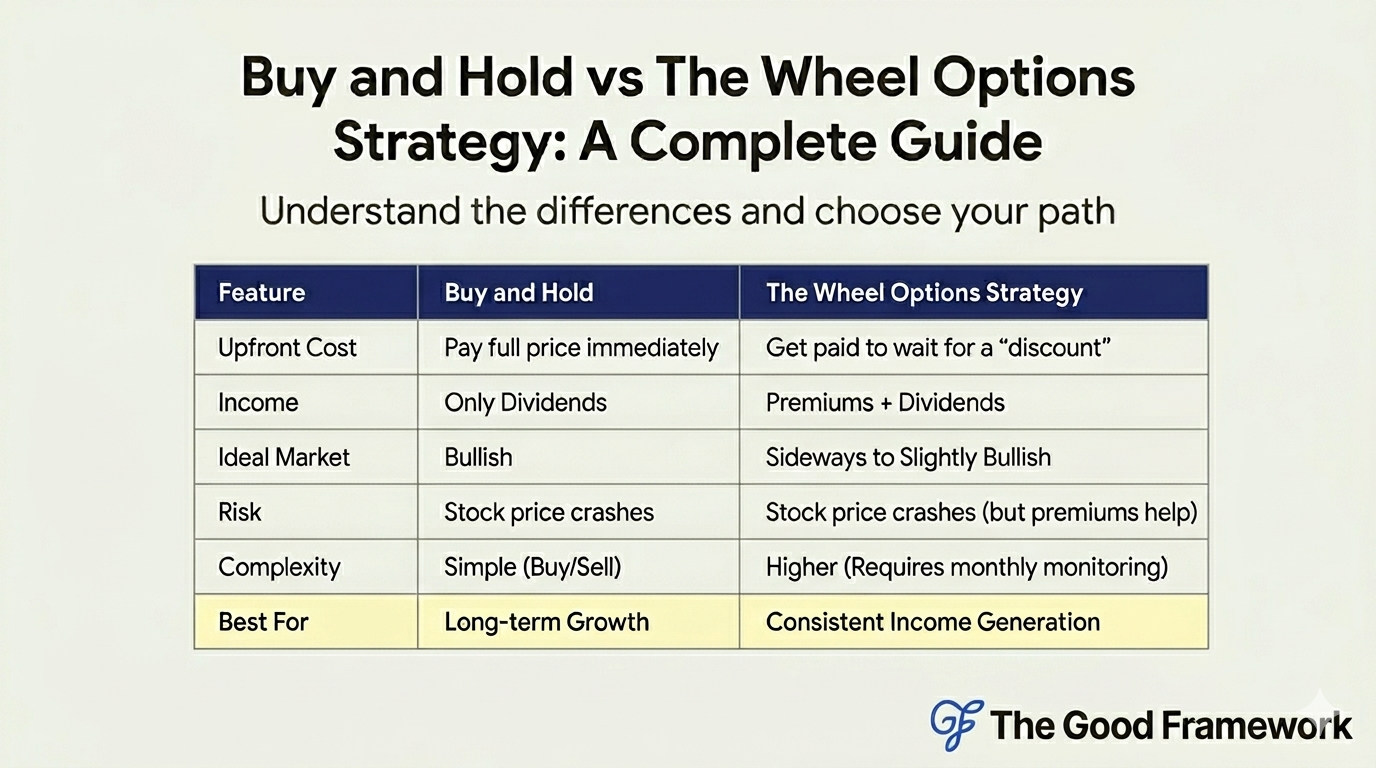
Comparison: The Wheel Options Strategy vs. Normal Investing
Is It Worth It?
The Wheel options strategy is fantastic for investors who
1. Have a bit of extra capital
2. Want to see more frequent "wins" than just waiting for a quarterly dividend check
However, don't get blinded by the "free money" aspect. Do take note that if a stock enters a massive dip in price, no amount of premium will save your portfolio from being in the red. Always do your research and treat it with the depth of a thesis but the execution of a savvy friend.
If you can stay disciplined and avoid the FOMO of chasing high-risk premiums on sketchy projects, you might just find that the Wheel is the smoothest ride in your financial journey.