
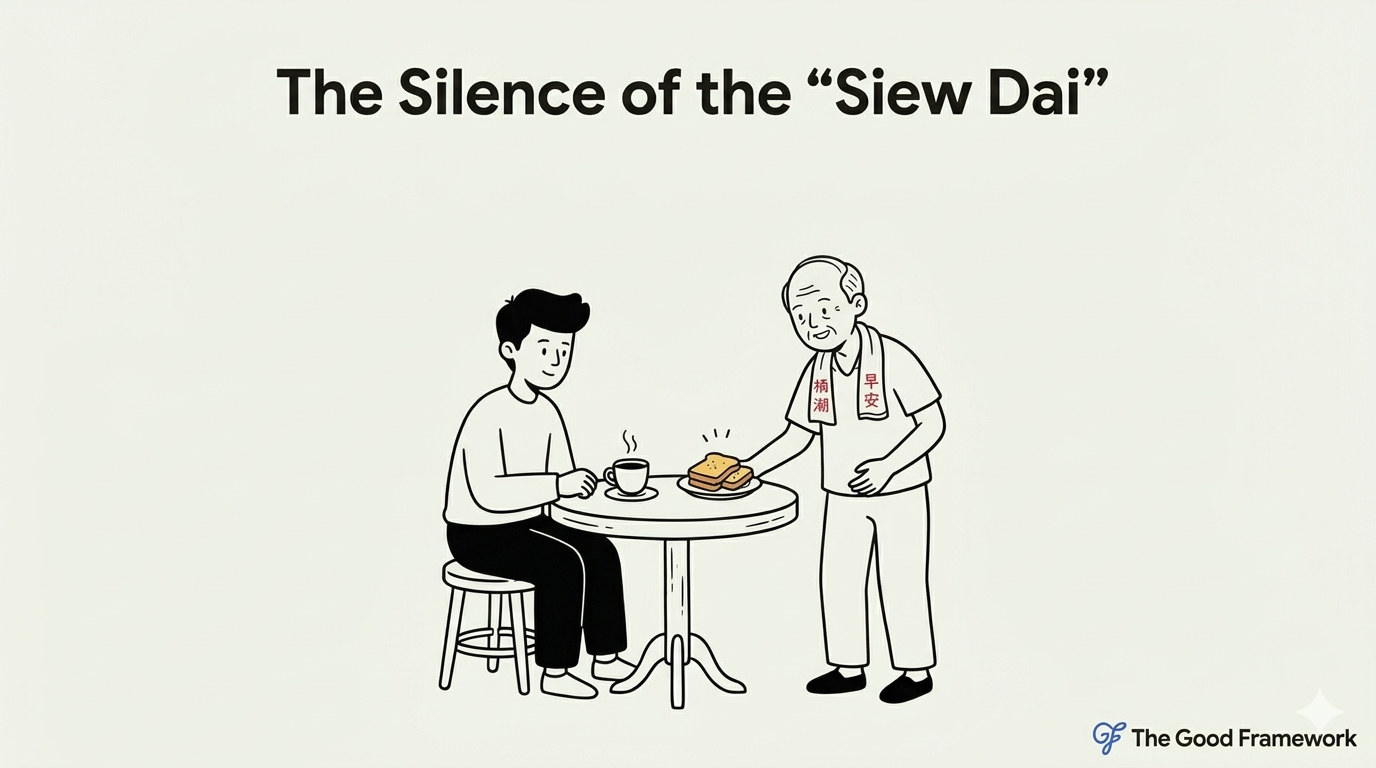
It is 8:15 AM at a 'kopitiam' in Yishun. The ceiling fans are suspiciously clean, but all they do is churn the stagnant air into a tepid soup of wok hey—that distinct, charred fragrance of a 'zi char' uncle’s existential rage and over-fried hor fun.
Underfoot, the floor is a tactical minefield of stickiness, glazed with the fermented residue of last night’s Tiger Beer bottles and the ghost of CPF payouts being incinerated one "Cheers!" by uncles and aunties who have decided that retirement is just a long-form way of saying "one more bottle, can or not?"
I’m standing in front of the drinks stall, my brain still a foggy mess of unread emails and existential dread.
That crushing realisation that it is only Tuesday.
"Uncle, one Kopi Siew Dai," I say, already reaching for my phone to pay.
The guy behind the counter is in his late 20s, wearing a crisp uniform rather than the good old usual Good Morning towel. He looks at me like I have just recited a spell in ancient Aramaic.
He blinks. Once. Twice.
"Sorry, coffee.. less sugar?" he replied, in textbook-perfect mandarin. I looked around to make sure that I am not in Shen Zhen for one of those work trips.
The 'Siew Dai' hangs in the air, a linguistic ghost that no longer has a home. My heart sinks. It’s not just about the coffee anymore; it is the realization that the secret handshake of our tribe is being deleted, one syllable at a time.
The Silence of the 'Siew Dai'
For decades, we were told that Singlish was a "handicap." Then Senior Minister Lee Kuan Yew raised his concern over the increasing use of Singlish during his speech at the Tanjong Pagar constituency’s National Day celebration in 1999.
The Speak Good English Movement treated our patois like a stubborn skin condition that needed to be scrubbed away. But now, it seems that we are not losing Singlish because we are getting better at English; we are losing it because the people who speak it are literally disappearing.
In 2025, Singapore’s Total Fertility Rate (TFR) plummeted to a historic, soul-crushing 0.87. That is not just "below replacement level". If anything, it is a demographic "Ctrl+Alt+Delete."
To put it in perspective, for every 100 Singaporeans today, we’re looking at only 44 children and a measly 19 grandchildren. Our population is shrinking. Drastically.
We are a nation that has mastered the art of "optimisation" so well that we have optimised our own replacement out of the budget.
The Math of Minority Status
If you look at the raw numbers from June 2025, the picture gets even bleaker for those of us clinging to our local 'true-blue Singaporean' identity:
- Total Population: 6.11 million.
- Singapore Citizens: 3.66 million.
- Non-Residents & Others (Excl. PRs): About 1.91 million and growing.
Right now, citizens make up about 59.9% of the total population. But when you factor in that our citizen growth is at a pathetic 0.7%, while the non-resident population is surging at 2.7%, the math is simple.
At this rate, within a couple of decades, the "True-Blue" Singaporean, the one who knows exactly how much oomph to put into a "WAH LAO EH" will be a minority in their own country and neighbourhood.
And it is not hitting everyone equally. The sociological breakdown is a grim reaper’s tally:
- Chinese Total Fertility Rate: 0.71 (Essentially a voluntary exit from the gene pool).
- Indian Total Fertility Rate: 0.92.
- Malay Total Fertility Rate: 1.53.
All well below the replacement rate of 2.1. We are not just an aging nation. We are a dissolving one.
The "Global City" Eviction
The "So What?" pivot is this: Singapore prided itself on being a "Global City," a frictionless hub where capital and talent flow is encouraged.
Does a "Global City" need a soul? It doesn't.
It doesn't need a dialect that relies on the tonal nuances of Hokkien or the rhythmic spice of Malay.
When your neighbourhood coffee shop is staffed by people who were recruited three weeks ago from a different country, the "Singlish" they learn is a caricature. It is the 'Can' and the 'Lah' used as a corporate slogan rather than a visceral expression of communal understanding. It’s a low-effort, performative expression of attempting to fit in as a "minority". A temporary mask worn until the day they realize they don’t need to perform for us anymore. Once the tipping point hits, the incentive to assimilate evaporates.
We are witnessing a Cultural Displacement. That fishball noodle auntie who used to scold me in a mix of three languages when I failed to make a decision on what I want to eat fast enough is being replaced by service staff who follow a script.
The Last 'Lah'
We are told that immigration is that "essential patch" for our demographic bug.
And sure, on a spreadsheet, 25,000 new citizens a year looks like an amazing solution. But you can’t "patch" the collective memory of a 1990s primary school canteen. You can’t white-paper your way into the soul of a syllable. Using 'Sian' to perfectly capture the crushing weight of the human condition isn’t a "competency" you pick up in a National Integration workshop; it is a generational reflex, born from decades of MRT breakdowns and the quiet desperation of the 7:15 AM commute.
Singlish is the language of the underdog. It is the beautiful thing that happens when you cram millions of people from different worlds onto a humid little island and tell them to make it wor." It is messy, it is difficult for an outsider to understand, and it is the only thing that actually makes us us.
When Singlish dies, and it will, the "citizen core" shrinks into a statistical footnote. We won’t just be speaking "Standard English." We’ll be speaking the language of a place that forgot it was a home and decided it was just a business.
Bojio, I guess. But soon, there won't be anyone left to invite anyway.